How do I comply with the Pennsylvania Act 101 recycling reporting requirements? And what can I do to use this information to help improve the efficiency of my fabrication, manufacturing or industrial operations? Can understanding my recycling information help me generate less scrap metal?
As Dan and Aileen explain in the video below there are many useful insights to gain from these reports and at Sahd Metal Recycling our focus is on getting the information to you in a timely fashion:
So, what are these reports and why are they so important to your operation? Well, townships and municipalities in the state of Pennsylvania need to report on how much recycling is going on within their areas and it needs to be credited back to these townships. We have very solid relationships with townships in most of our region, but in particular in Lancaster and York counties and we work together to help them get as much credit for the metal recycled in their particular region. Because we work as a private hauler for our customers, all they need to do is take our report totals and checkmark the private hauler option and send that paper and our report to their township–it’s just that easy!
But, that’s not all. Just like the importance of reviewing ticketing reports that come with your prompt payment for your metals there is a treasure trove of information to help your operation. Combining the purchasing department’s information on what metal buying you are doing with the recycling report information can help you understand how efficiently you may be running as an organization. Questions that would come out include some of the following that can help your organization:
“Can I improve nesting on the laser to cut more parts out and reduce scrap?”
“Can I buy a different length of material for some aluminum or steel jobs so my drops are smaller?”
“Are certain customers or jobs more scrap intensive than others and is that good or bad for my business”
“Am I sorting my scrap metal in the most efficient way possible, could I use more dumpsters or more containers to make more money”
All of the answers to these questions and more are embedded in your sustainability reports. This data can help you figure out if certain sorting or even recutting on the laser will benefit your operation. We will be able to pay more for material sized smaller than 3 feet in length if it’s regular mill steel and under 18×24 inches if it is mild steel or A36 steel. Similarly for aluminum and other non ferrous grades cutting smaller, sorting better or segregating totally can lead to big savings payouts for your metal recycling program.
We are always open to come out and take a look to see if we can help you maximize revenue in your scrap program. We realize that scrap is wasted efficiency and potentially dollars in your organization and the less you have the better you perform! If you’d like us to come out and look at your operation don’t hesitate to ask.
Finally, it goes without saying that diverting waste from landfills and limiting the amount of ore we have to extract from the ground for new metals makes recycling some of the most sustainable activities we can be engaged in. We like to give our customers a look at the impact they are making in reducing CO2 emissions by running an effective recycling program. Here’s a chart we use to estimate CO2 reductions per pound of metal.
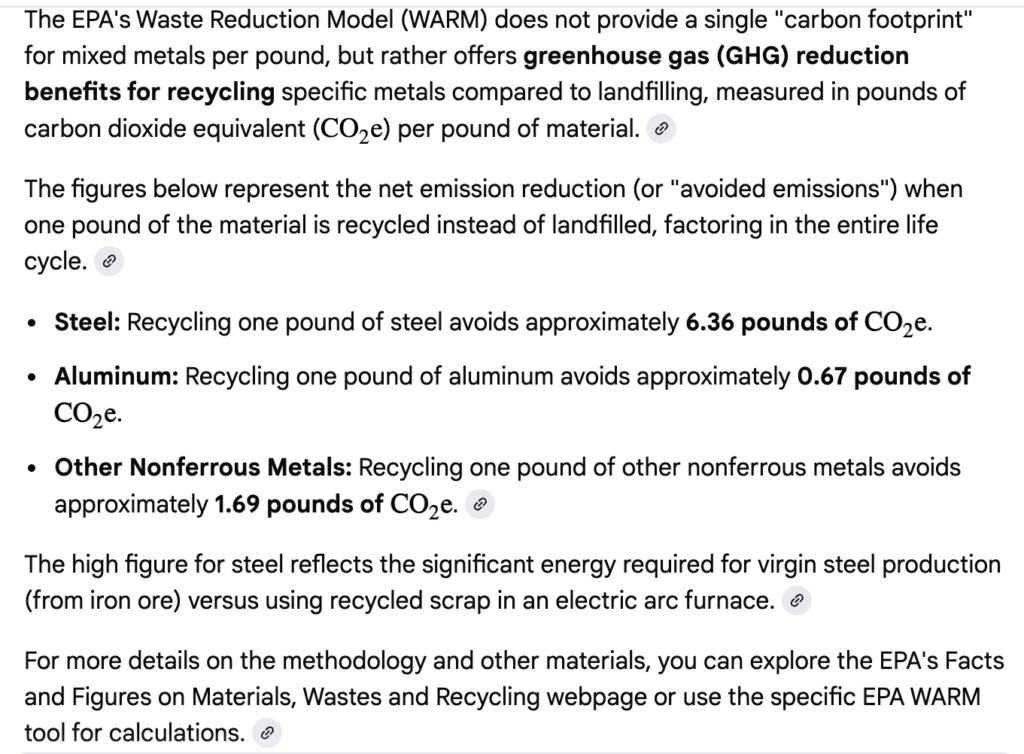
So, understanding the composition of our company’s mix of recycling (approximately 90% ferrous or steel by weight and 10% non-ferrous) we conservatively estimate 5.88 pounds of CO2 reduction per pound of metal recycled.
As we launch into 2026, taking stock of how we all performed in every aspect of our operation in 2025 is of great importance. That’s why we are so proud to generate these reports right at the beginning of the year, the goal is to make us all better and all more sustainable!